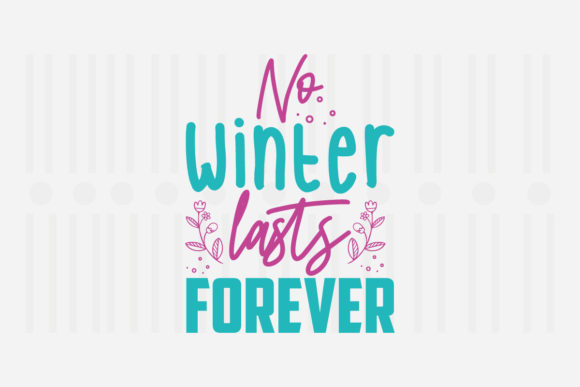
No Winter Last Forever: A Designer’s Take on Spring SVG
As someone who has spent years staring at screens filled with vector paths and then watching those same lines transform into thread on fabric, I have developed a keen eye for what works and what doesn’t. When I first opened the file labeled No Winter Last Forever,spring Svg, my initial reaction was one of cautious optimism. The phrase itself carries a weight that resonates deeply in the world of handmade goods. It speaks to resilience, hope, and the natural cycle of renewal—themes that are perennially popular in the Crafts sector. But as an embroidery product reviewer, I am not here to judge the poetry; I am here to judge the practicality.
The product description highlights that this is a Spring SVG Quote, ready to print, with easy color changes and source files included in EPS or SVG formats. For a digital designer, this is standard. For an embroiderer, however, the jump from a scalable vector graphic to a stitched embroidery design requires careful translation. Let us walk through how this specific asset performs when moved from the digital realm of Graphics into the tactile reality of a finished product.
First Impressions and Visual Mood
The layout of No Winter Last Forever,spring Svg suggests a clean, typographic approach. In my experience, text-based designs are deceptively simple. They look effortless on a screen, but they demand precision in execution. The mood here is uplifting yet grounded. It is not overly decorative, which makes it versatile. I can immediately envision this working well for a minimalist aesthetic. The lack of complex illustrative elements means the focus remains entirely on the message. This is crucial for items where readability is key, such as tote bags or wall hangings.
When evaluating the visual personality, I look for balance. Does the text flow naturally? Are the letterforms sturdy enough to withstand the distortion that sometimes occurs during stitching? From what I can see in the vector preview, the lines appear consistent. This is a good sign. It suggests that if digitized correctly, the resulting stitch density could be managed without creating a stiff, cardboard-like feel on the fabric.
Real-World Application: The Tote Bag Test
To truly test a design, I imagine it on a specific item. Let us consider a custom embroidered tote bag. This is a staple for any Etsy seller or small shop owner. Canvas is a forgiving fabric, providing a stable base for stitching. If I were using No Winter Last Forever,spring Svg for this project, I would likely choose a contrasting thread color to make the quote pop. Imagine deep forest green thread on a natural beige canvas. The contrast would highlight the elegance of the font.
However, the transition from SVG to embroidery is not automatic. Since the product includes EPS and SVG files, you will need to use digitizing software to convert these vectors into an embroidery file compatible with your machine. This is where the "easy change color" feature mentioned in the description becomes relevant. While you can change colors in your vector software before digitizing, the real test is how the design handles thread transitions. A design like this, relying on text, benefits from minimal color breaks. I would recommend keeping it single-color for a sleek, professional look, unless you are aiming for a specific artistic effect with multi-colored threads.
Navigating Fabric and Technique Challenges
Not all fabrics behave the same way. If you are planning to use this design on a stretchy material, such as a sweatshirt or baby clothes, you must proceed with caution. Text designs can distort if the fabric pulls during stitching. Here, the choice of stabilizer is non-negotiable. A cut-away stabilizer would be my go-to for garments that will be washed frequently, ensuring the finished product retains its shape and the letters do not pucker.
For curved surfaces like caps, the challenge increases. The phrase "No Winter Last Forever" is relatively long. On a small hoop or a curved cap panel, you might need to adjust the size significantly. This brings us to a critical point: check the legibility at smaller sizes. Tiny lettering can become a mess of thread if the satin stitch width is too narrow or if the running stitch outlines are not precise. I always advise testing on scrap fabric first. Do not assume the design will scale down perfectly without losing detail.
Dark fabrics present another hurdle. If you are stitching light thread on dark fabric, you may need to add an underlay stitch to prevent the background color from showing through. This adds bulk, so you must balance aesthetics with comfort. For a personalized gift like a baby blanket, comfort is paramount. You do not want a dense block of stitches that feels rough against sensitive skin.
Commercial Viability and Brand Consistency
For commercial embroidery professionals and craft business owners, the value of a design lies in its marketability. This particular quote taps into a universal sentiment. It is safe yet meaningful, making it an excellent candidate for holiday gifts or spring-themed collections. It fits well within the niche of inspirational home decor and apparel.
When creating printable mockup images for your online store, remember that the SVG format allows for crisp scaling. You can generate high-resolution previews that show potential customers exactly how the text will look. This builds trust. Buyers want to see clarity. A blurry mockup suggests a blurry final product. Use the source files to create clean, professional presentations that highlight the design’s versatility across different thread colors.
It is also worth noting the licensing aspect. The description mentions "Source File eps or svg FILE INCLUD," but it does not explicitly state the commercial license terms for the digitized embroidery file. As a responsible designer, I must remind you to verify the license before selling finished items. Some creators allow unlimited sales of physical products, while others have restrictions. Always clarify this to protect your small shop product line.
Practical Notes for the Embroiderer
- Test Stitch First: Always run a test on similar fabric to check for puckering or thread breaks.
- Contrast Check: View your design in black and white to ensure the letterforms are distinct and readable.
- Hoop Size: Confirm that your hoop can accommodate the full width of the phrase without resizing it to illegibility.
- Thread Quality: Use high-quality rayon or polyester threads to enhance the sheen and durability of the text.
- Digitizing Settings: If you are digitizing this yourself, pay attention to pull compensation. Text often requires slight adjustments to maintain sharp corners.
In conclusion, No Winter Last Forever,spring Svg offers a solid foundation for a variety of projects. Its strength lies in its simplicity and emotional resonance. However, its success depends entirely on the skill of the embroiderer and the quality of the digitizing process. Treat it not just as a graphic, but as a blueprint for texture and form. With the right preparation, it can elevate a simple tote bag design or sweatshirt embroidery into a cherished keepsake. Keep your stabilizers handy, your needles sharp, and your expectations realistic. Happy stitching.